
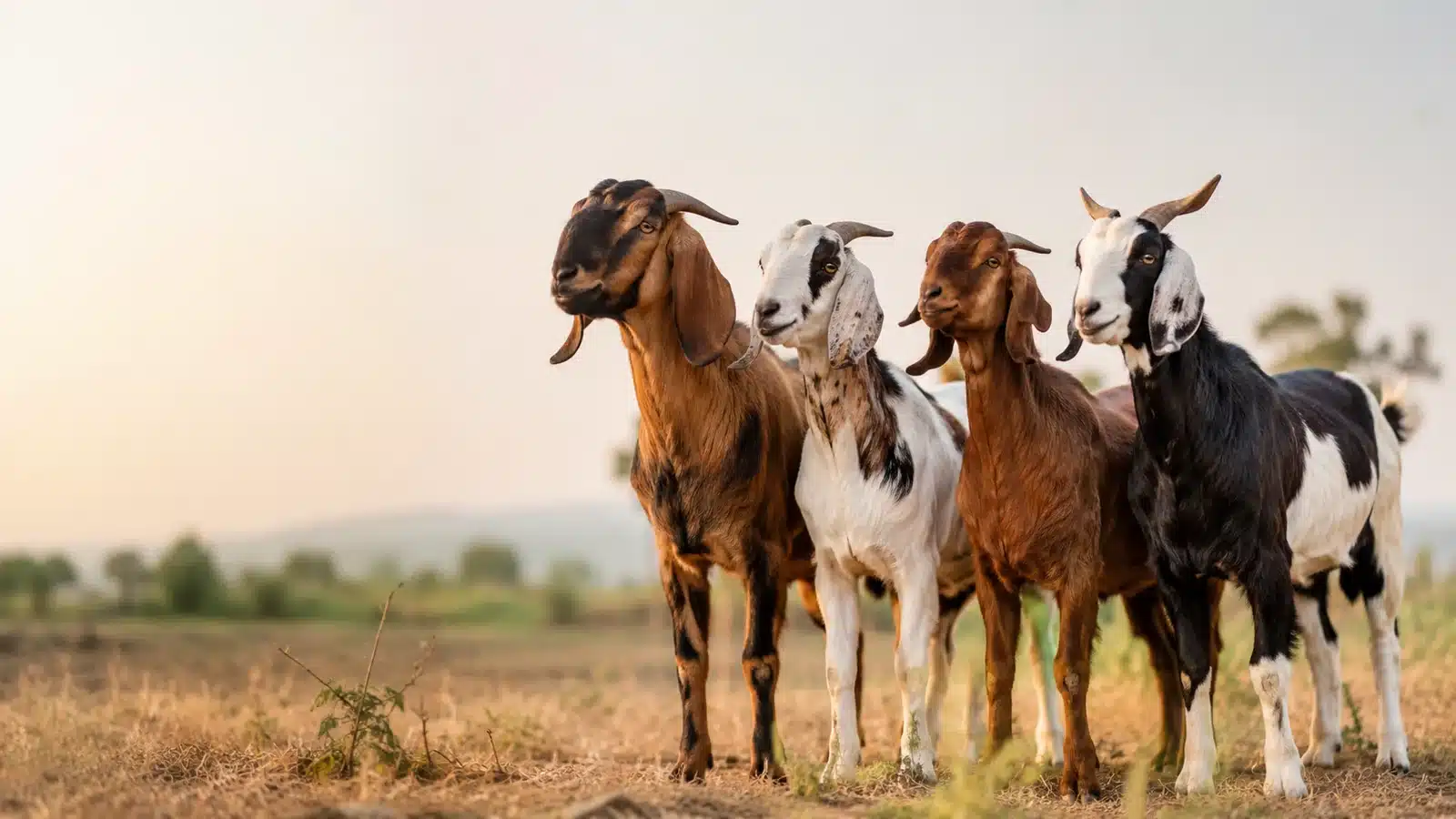

How to Choose the Right Goat Breed for Your Farm
A decision framework for matching a goat breed to your climate, market and management system — before you shortlist from our 37 breed profiles.
If there’s one question every new farmer asks, it’s “which is the best breed?” The honest answer: there isn’t a single best breed — there’s a best-fit breed for your climate, feed, labour and market.
Why the “Best Breed” Question Has No Single Answer
Pick the right fit and your goats gain weight steadily, kid on time, resist local disease, and fetch better prices. Pick the wrong fit and you’ll fight heat stress, parasites, slow growth, and disappointing margins. This guide gives you a simple way to choose — mapping India’s major goat breeds to climate zones and market goals, with practical profiles and a plain-language look at crossbreeding. Want the full spec-by-spec comparison once you’ve shortlisted? Use the Breed Comparison Tool after reading this.
India’s Workhorse Breeds — Quick Profiles
Weights and yields vary by nutrition and management — treat these as practical expectations, not fixed rules. Click through for the full profile, price range, and care guide on each breed.
| Breed | Home Turf | Best For |
|---|---|---|
| Sirohi | Rajasthan, semi-arid | Semi-intensive/stall-fed in dry regions; meat + breeding stock side-income |
| Barbari | Western UP, Rajasthan/MP | Stall-fed units near cities; small landholdings; high prolificacy |
| Beetal | Punjab, North India | Semi-intensive/stall-fed in plains; dual meat + milk |
| Jamunapari | UP (Chambal region) | Brand-building, breeding stock, festival premiums |
| Osmanabadi | Maharashtra, semi-arid | Semi-intensive across the Deccan; hardy all-rounder |
| Black Bengal | West Bengal, NE India | Humid zones with strong kid management; super prolific |
| Jhakrana | Rajasthan (Alwar) | Semi-intensive/stall-fed with a milk/value-added side |
| Malabari | Kerala, coastal/humid | Coastal/humid belts with strong biosecurity |
| Surti | Gujarat | Smallholder stall-fed units, steady local meat demand |
| Zalawadi / Kutchi | Saurashtra–Kutch, arid | Extensive/semi-intensive in dry belts |
| Gaddi / hill-type | Himalayan foothills | Hilly/temperate zones, transhumant or semi-intensive |
What to Choose by Zone
| Zone | Recommended Breeds |
|---|---|
| Rajasthan / Haryana (arid–semi-arid) | Sirohi, Barbari, Jhakrana; (Gujarat) Zalawadi/Kutchi |
| Punjab / UP plains | Beetal, Jamunapari, Barbari (stall-fed), Jhakrana |
| Maharashtra / Karnataka (Deccan) | Osmanabadi, local Deccan types, Beetal crosses (stall-fed) |
| Kerala / coastal TN-KA / Odisha (humid) | Malabari, local coastal types, Black Bengal (east) |
| Bengal / NE | Black Bengal, Assam local lines |
| Hills | Gaddi/hill-type, local hill breeds |
Choosing by Market Goal
- Daily meat market (butchers): consistent 22–30 kg liveweight growers, batch supply, disease-free — Sirohi, Osmanabadi, Barbari, Malabari, Black Bengal (sold younger).
- Breeding stock: breed-typical bodies, clean udders, strong feet, documented vaccine/kidding history — Beetal, Barbari, Sirohi, Osmanabadi, Jhakrana, Jamunapari.
- Festival/Qurbani premium: big, attractive bucks, solid colours, good horns/ears — Jamunapari, Beetal, Sirohi, Sojat-type lines.
- Milk/value-added: Beetal, Jhakrana, Jamunapari — only with hygiene, milking routine, and feed quality in place.
Crossbreeding & Upgrading — Without Losing Your Shirt
Crossbreeding is tempting — “bigger kids, faster growth.” It can backfire if you lose local hardiness.
What to Look for When Buying
Both does and bucks
- Bright eyes, shiny coat, steady rumination, no nasal/eye discharge or chronic cough.
- Even gait, correct feet/legs; reasonable bite/teeth alignment for age.
- Skin free of mange/lice, clean tail area.
Does (breeding females)
- Soft, well-attached udder with two functional teats, no hard lumps or mastitis scars.
- Feminine head/neck, roomy middle, good pelvis width.
- Twinning history if farm records are available.
Bucks (breeding males)
- Masculine head/neck, wide chest, strong back and legs.
- Testicles even and firm with adequate circumference for age, clean sheath.
- Active libido, not overly fat.
Starter Sets — Combos That Work
Dry belt, semi-intensive, meat focus (80 does + 3 bucks)
60 Sirohi + 20 Barbari does, 2 Sirohi + 1 Barbari buck → hardy base with steady twinning, growers sold at 24–30 kg.
Plains, stall-fed near city, meat + breeding (80 does + 3 bucks)
40 Beetal + 30 Barbari + 10 Sirohi does, 2 Beetal + 1 Barbari buck → attractive frames for the breeding market, Barbari lifts kid numbers.
Humid/coastal, semi-intensive, low-input meat (80 does + 3 bucks)
60 Malabari + 20 local coastal-type/Black Bengal crosses, 2 Malabari + 1 local buck → parasite-aware genetics; keep the deworming calendar tight.
Myths vs. Facts
- Myth: Bigger breed = automatically more profit. Fact: Bigger frames eat more — profit is weight gain per ₹ of feed, not size alone.
- Myth: Cross with an exotic and your problems vanish. Fact: You may gain growth but lose disease/heat tolerance. Keep a hardy base.
- Myth: Black Bengal is too small to be profitable. Fact: In humid belts, high prolificacy + local premium + low input can beat larger breeds on net margin.
- Myth: Milk breeds are easy money. Fact: Milk demands hygiene, chilling/processing, and a daily routine — worth it only with that system in place.
Your Buying Plan
- Shortlist 2–3 breeds that fit your climate and market.
- Visit two farms per breed — check sheds, feet, udders, kid pens, record books.
- Start with 15–25 head in Batch 1 (quarantine 15–30 days).
- Test performance on your ration — weigh kids at 30/60/90 days, track ADG.
- Add Batch 2 and 3 based on what actually performed.
- Lock a buck plan — bring an unrelated buck every 12–18 months to avoid inbreeding.
- Document everything — records are what let you sell breeding stock at a premium.
Quick if-then picks: hot, dry, semi-intensive grazing → start with Sirohi or Osmanabadi. Near a city, stall-fed, good fodder → mix Beetal (frame) with Barbari (prolificacy). Humid/coastal → Malabari or local coastal types, Black Bengal in the east. Want a milk side business → Beetal or Jhakrana, only with hygiene and ration discipline. Want festival premiums → raise a few standout Jamunapari/Beetal/Sirohi bucks with extra finish.
- There is no single “best breed” — only the best fit for your climate, feed, labour and market.
- Pick one primary breed and one supporting breed for your zone, then line up two farm visits for each.
- Prepare your quarantine pen and record sheets before your first batch arrives.
- Buy small, buy smart — let your own weight and kidding data, not rumours, decide who stays in your herd.
Frequently Asked Questions
Still not sure which breed fits your farm?
Ask our team which breed fits your climate and market — or compare breeds side by side.
Related Articles
Don’t miss similar guides
Get practical goat-farming guides delivered every week.