Gaddi Goat
The Gaddi is a hardy mountain breed of the western Himalayas, reared by the pastoral Gaddi shepherds of Himachal Pradesh, Jammu & Kashmir and Uttarakhand. Covered in a long white (sometimes black or brown)…

Breed Overview
The Gaddi is a hardy mountain breed of the western Himalayas, reared by the pastoral Gaddi shepherds of Himachal Pradesh, Jammu & Kashmir and Uttarakhand. Covered in a long white (sometimes black or brown) coat, it is bred for hair, meat and as a pack animal on migratory hill routes.
Adapted to cold, high-altitude terrain, the Gaddi is a sure-footed, resilient breed central to the transhumant lifestyle of Himalayan herders, migrating between valley and alpine pastures with the seasons.
Key benefits of the Gaddi Goat
- Superbly adapted to cold Himalayan mountains
- Long coat gives useful hair alongside meat
- Sure-footed and usable as a pack animal
- Very economical on natural alpine grazing
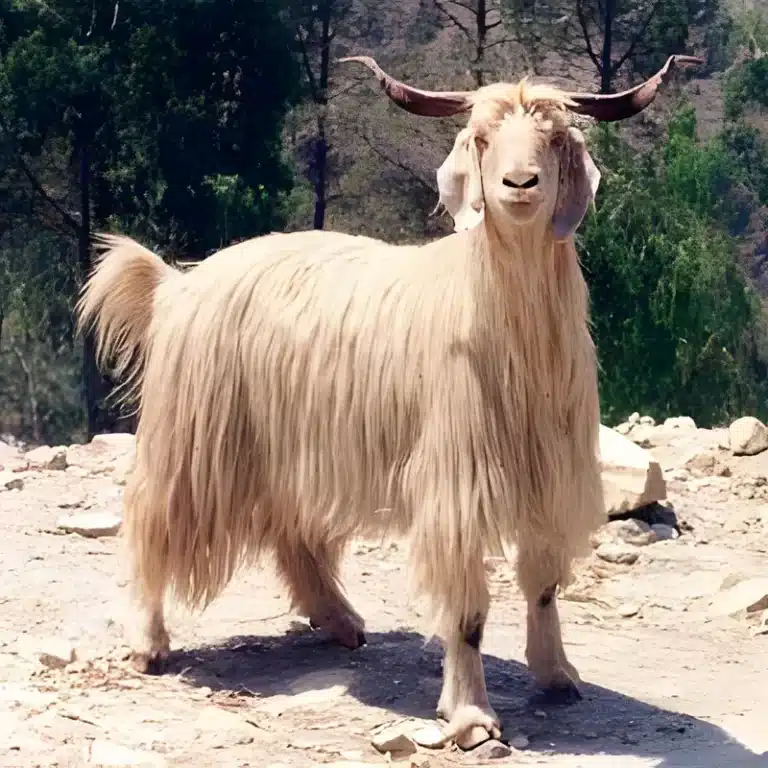
- Long white coat (also black or brown)
- Compact, sturdy, sure-footed mountain frame
- Medium ears and spiralled horns
- Bred for hair, meat and as a pack animal
🐐Physical Characteristics
A compact, sturdy mountain breed with a long coat, most often white but also black or brown. It has medium ears, spiralled horns and strong legs and hooves suited to steep, rocky Himalayan terrain.
🥛Milk Production
A low 0.5–1 litre/day — enough to rear kids, as the breed is valued for hair, meat and transport rather than dairy.
🌦Climate Suitability
Superbly adapted to cold, high-altitude mountains. Its long coat protects against Himalayan cold, and it moves easily between valley and alpine pastures on seasonal migrations.
🌾Feeding Requirements
Grazes alpine meadows and hill browse through the migratory cycle, needing little supplementation. Extremely economical for the transhumant herding it is bred for.