
Farm planning files, ready to print. Vaccination, deworming, shed, feeding and records - in 8 languages.Browse downloads
India’s Most Trusted Goat Farming Knowledge Hub Mon – Sat: 9:00 AM – 6:00 PM
Damascus Goat
EXOTIC BREED · DUAL PURPOSE

Damascus Goat

Damascus Goat
Share: fWX

Quick Facts

📍OriginMiddle East (Syria)
🐐Breed TypeDual (Milk + Meat)
⚖️Weight65–90 kg
📏Height78–95 cm
🥛Milk Production3–4 L/day
📅Life Span12–15 yrs
🌦️ClimateWarm-tolerant

Breed Overview

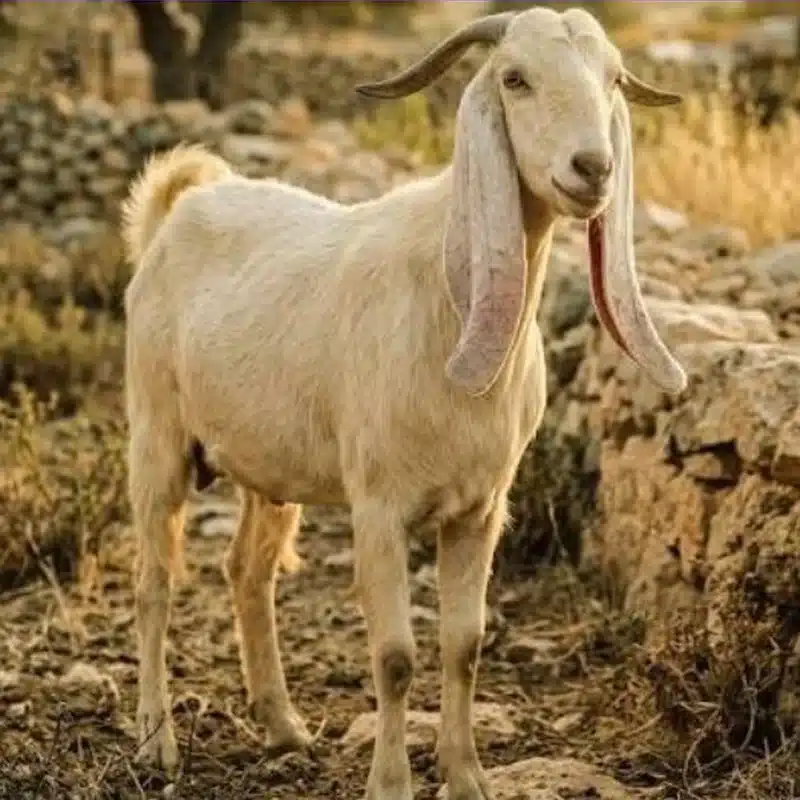
The Damascus, also called the Shami, is a large dual-purpose breed from the Middle East — Syria, Lebanon and Cyprus. Reddish-brown and unmistakable for its strongly convex face and very long pendulous ears, it is prized for high milk yield, good meat and remarkable prolificacy.

Heat-tolerant and fast-growing, the Damascus is one of the most productive Middle-Eastern dairy breeds and adapts well to warm climates, making it a strong exotic option for Indian conditions where good management is available.

Key Characteristics
  • Reddish-brown coat; large, powerful frame
  • Strongly convex Roman face
  • Very long, wide pendulous ears
  • High milk yield plus good meat and prolificacy

🐐Physical Characteristics

A large, powerful dual-purpose breed, usually reddish-brown, with a dramatically convex Roman face and very long, wide pendulous ears. It has a deep, well-muscled body and a strong, well-attached udder.

🥛Milk Production

A high yield of 3–4 litres/day over a long lactation, with good milk quality — among the best of the Middle-Eastern dairy breeds and well above indigenous Indian goats.

🌦️Climate Suitability

Bred in the warm Middle East, it is notably heat-tolerant and adapts well to warm Indian conditions with basic shade and shelter — an advantage over the Swiss dairy breeds.

🌾Feeding Requirements

A large, productive breed needing about 5–6 kg green fodder plus 600–800 g concentrate per adult daily to sustain its high milk and fast growth.

Advantages & Disadvantages

✓ Advantages
High milk yield plus good meat
Heat-tolerant — well-suited to warm climates
Fast-growing and prolific
Large, valuable breeding stock
✗ Disadvantages
Very large frame needs good feed and housing
Purebred stock rare and costly in India
Distinctive face is polarising to some buyers

Tips for Beginners

1
Buy from certified breeders
Insist on documented lineage and a health card to guarantee purebred, disease-free stock.
2
Build raised, airy housing
A dry, well-ventilated shed with slatted flooring prevents hoof rot and respiratory disease.
3
Vaccinate on schedule
Follow the PPR, ET and FMD schedule from day one — prevention is far cheaper than treatment.
4
Balance the ration
Combine green fodder with a mineral-rich concentrate to sustain healthy growth and milk yield.
5
Start small, scale steadily
Begin with 5–10 does and one quality buck; expand only once you master routine management.

Frequently Asked Questions

It is a large, heat-tolerant Middle-Eastern dual-purpose breed prized for high milk yield (3–4 litres/day), good meat, fast growth and prolificacy — plus its unmistakable convex face and very long ears.
Yes, with good management. Unlike the Swiss dairy breeds it is bred for warm climates and tolerates heat well, making it one of the better exotic dual-purpose options for Indian conditions.
Yes — Damascus and Shami are two names for the same Middle-Eastern breed, originating in Syria, Lebanon and neighbouring regions.

Interested in starting with Damascus goats?

Talk to our team for a personalised farm plan, or reach out with any questions about getting started.

Related Breeds

View All Breeds →